Poet PT-10 - Desert Moon Audio plug-in

Poet

$59.00
Skip to product information
Poet PT-10 - Desert Moon Audio plug-in

Poet

Poetry Synthesizer

Nine voices, a keyboard in the shigin scale and a memory that plays back what you play

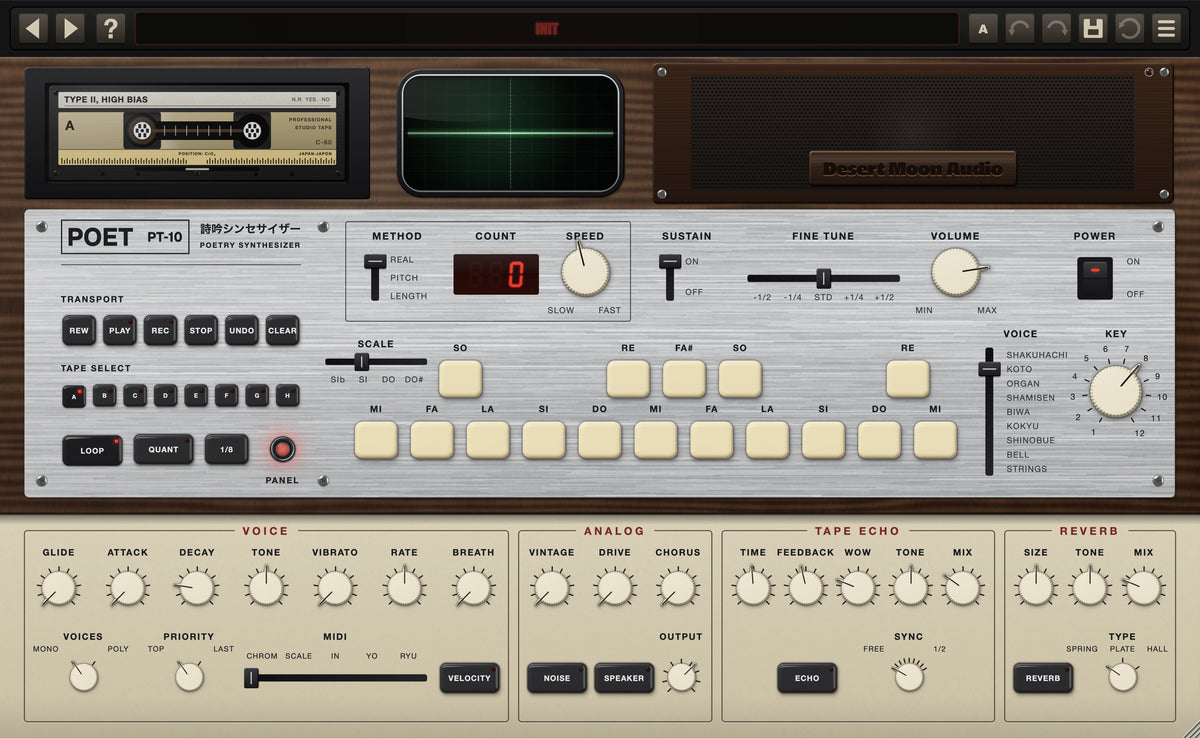
Poet is a poetry synthesizer plugin for Mac and PC: an instrument built around three measured voices — koto, shakuhachi and pipe organ — with a two-row keyboard tuned to the shigin scale, a lingering-sound switch, key and fine tune, and an electronic memory with a cassette-style transport. Six more modeled voices, eight-voice polyphony, glide, vibrato and breath, the instrument's own speaker, a tape echo, three reverbs and a chorus live on the fold-out lower panel.

14-DAY FREE TRIAL

Full version, free for 14 days. No payment details needed.

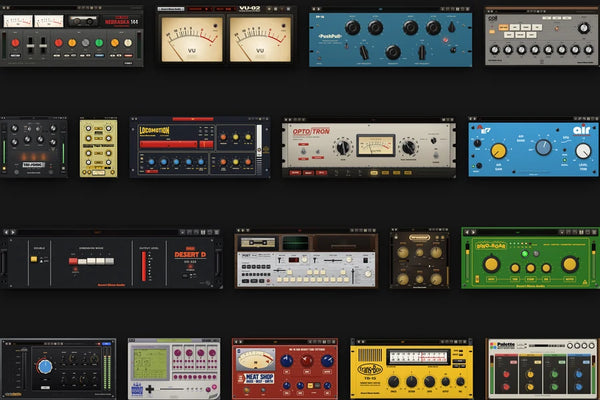
Every Desert Moon Audio plug-inSave 50%

Everything Bundle

Every plug-in

$564 $1,128

Plus 30% off every plug-in we release after this.

See what's in it →

Works with all major DAWs

AU / VST3 / AAX for Mac · VST3 / AAX for PC

Yours forever — no subscription

Instant download · free updates for life

Hear the difference

Press play to hear Poet through its effects panel: tape echo, reverb, chorus and the ANALOG wear. Tap CLEAN for the same performance with the effects switched off, at the same moment.

Koto Garden
Shakuhachi Wind
Temple Bells
Temple Organ

Where it goes

Four of the places it lives.

  • A line in a song

    Mono, a little GLIDE, VIBRATO around 30, BREATH up on the shakuhachi: a melody that slides and sings over a track, with a synced echo behind it.

  • Pads and beds

    POLY, ATTACK up, DECAY long, the koto or the strings under a hall: eight voices make a bed that moves the way a played instrument does.

  • Loops under a track

    Record a phrase with METHOD on PITCH, switch on LOOP and QUANT at 1/8, and press play on the host: the memory plays in time, and a different tape on the chorus.

  • The instrument in the room

    SPEAKER on MIC, NOISE on, VINTAGE at 20 and nothing else: what a recording of the thing itself sounds like, hum and all.

About Poet

Poet is an instrument. Its three main voices — koto, shakuhachi and pipe organ — were rebuilt from measurements of a real instrument's output: harmonic tables at several pitches, the envelope shapes and release rates, the koto's closing filter and its pitch-dependent decay. They play from a two-row keyboard tuned to the shigin scale, with SUSTAIN for the lingering sound, KEY from 1 to 12, a FINE TUNE a quarter or a half key either side, and a SCALE switch for what the SI key sounds. Play it on screen, from the computer keyboard or from a MIDI keyboard, chromatically or pulled onto the scale.

The memory is a cassette-style recorder: press REC, play, press PLAY and it plays the phrase back on any voice at any speed, round and round with LOOP, or snapped to the host's tempo with QUANT. It records in real time, or the pitches and the durations separately, onto eight tapes that are kept with the session and can be exported as MIDI.

The lower panel is everything the instrument never had, built to sit beside it: shamisen, biwa, kokyu, shinobue, bell and strings as physical-model plucks and bowed and blown models that never play the same note twice; mono with glide or eight-voice poly; vibrato, breath and velocity; VINTAGE wear and the unit's own noise; the internal speaker, or that speaker through a microphone in the room; DRIVE; and a tape echo, spring, plate and hall reverb and a chorus, laid out like a bench instrument.

Key features

  • Poet – The deck and the memory

    The deck and the memory

    A cassette-style recorder with eight tapes. METHOD records in real time, or the pitches and the durations separately; COUNT shows the steps on the tape; SPEED plays it back from a quarter to four times. The monitor tube shows the oscillator's wave as it plays.

  • Poet – A keyboard in the shigin scale

    A keyboard in the shigin scale

    Two rows of keys with their names printed on them, played on screen, from the computer keyboard or from MIDI. SCALE sets what the SI key sounds; the MIDI map plays chromatically or pulls notes onto the keyboard's scale, or the in, yo and Ryukyu scales.

  • Poet – The transport

    The transport

    REW, PLAY, REC, STOP, UNDO and CLEAR, eight tapes to choose from, LOOP to play round and round, and QUANT to snap playback to the host's grid at 1/16, 1/8 or 1/4. Tapes export as MIDI files from the preset bar's menu.

  • Poet – Nine voices, KEY and FINE TUNE

    Nine voices, KEY and FINE TUNE

    Shakuhachi, koto and pipe organ measured from the real instrument; shamisen, biwa, kokyu, shinobue, bell and strings as Poet's own physical models. KEY tunes the keyboard from 1 (G) to 12 (F sharp); FINE TUNE moves it a quarter or a half key either side.

  • Poet – Lower panel: VOICE

    Lower panel: VOICE

    MONO with TOP or LAST note priority and GLIDE, or eight-voice POLY. ATTACK adds to the voice's own, DECAY stretches it from a quarter to four times, TONE darkens or brightens, VIBRATO and RATE, BREATH for the blown voices, VELOCITY on or off, and the MIDI map.

  • Poet – ANALOG

    ANALOG

    VINTAGE adds the drift and note-to-note variation of an older unit, NOISE its hum and hiss. SPEAKER plays the instrument's own internal speaker, or that speaker heard through a microphone in the room. DRIVE pushes the output amplifier; CHORUS widens; OUTPUT trims.

  • Poet – TAPE ECHO

    TAPE ECHO

    A tape loop echo: TIME from 40 ms to 1.5 s or synced to the host at any note value, FEEDBACK that runs away the way tape does, WOW for speed wobble on the repeats, TONE for how dark each repeat gets, and MIX.

  • Poet – REVERB and CHORUS

    REVERB and CHORUS

    SPRING with its drip, PLATE with its dense bloom, or HALL; SIZE, TONE and MIX. A chorus after the voice, from a shimmer to a wide wash. Every switch lands in silence and every control fades.

Poet panel, with its controls numbered

The panel at a glance

  1. Cassette window The tape in the deck, its name and counter. Eight tapes record what you play.
  2. Monitor tube The oscillator's own wave, drawn as it plays.
  3. Method, Count, Speed How the memory records, how many steps it holds, and how fast it plays back.
  4. Sustain On, a note rings out at the voice's own release after the key is let go; off, it stops with the key.
  5. Fine Tune A quarter or a half key either side of standard, for tuning to a recording or a voice.
  6. Volume The instrument's own level, before the lower panel.
  7. Power The host's bypass: the pilot lamps go out and the instrument falls silent.
  8. Transport Rewind, play, record, stop, undo and clear for the memory.
  9. Tape select Eight tapes, A to H, kept with the session.
  10. Loop & Quant Loop plays round and round; Quant snaps the notes to a 16th, 8th or quarter of the host's beat.
  11. Scale What the SI key sounds: four positions, four scales, and the rest of the keyboard stays put.
  12. Keyboard Two rows in the shigin scale. Play it with the mouse, the computer keyboard or a MIDI keyboard.
  13. Voice Shakuhachi, koto and pipe organ, measured from a real instrument, plus shamisen, biwa, kokyu, shinobue, bell and strings.
  14. Key 1 to 12: the key the keyboard is tuned to, in semitone steps.
  15. Voice shaping Glide, attack, decay, tone, vibrato, breath, mono or poly, the MIDI map and velocity.
  16. Analog Vintage wear, drive, chorus, noise and the unit's own speaker.
  17. Tape echo Time, feedback, wow, tone and mix, free or synced to the host.
  18. Reverb Spring, plate or hall, with size, tone and mix.

More details

Is there a free trial?

Yes — 14 days, fully featured, from the first time the plugin loads. Every voice, every control, no interruptions and no signup. When the trial ends, audio passes through dry until a license is entered, so your sessions always open.

Do I own this plugin forever?

Yes. It's a one-off purchase, not a subscription, and there's nothing to renew. Updates to a plugin you own are free — download the current installer and run it over the top.

Every plugin is sold on its own, so you can buy just the one you want.

How many computers can I install it on?

Your license covers up to 4 computers you personally own — studio desktop, laptop, spares. Enter the same key on each; the first activation on a machine takes one quick internet check; after that it works offline, apart from a once-a-day check for a newer version. Moving on from a computer? Deactivate This Machine in the plugin's preset menu hands the seat back, and if a machine dies before you can, just ask us.

How do I get my download?

Your download link and license key are in the order confirmation email sent at purchase. Run the installer, open Poet, click the orange strip along the bottom of the plugin, paste the key and press Activate. Done.

Can’t find the email? Check spam, then write to info@desertmoonaudio.com and we’ll resend it.

Can I run it offline?

Yes — after activation. Entering your license key needs an internet connection once; from then on it works offline — the only other time it goes online is a once-a-day check for a newer version.

Tech specs

Mac: AU, VST3 and AAX — universal, native on Apple Silicon and Intel. macOS 10.15 or later.

Windows: VST3 and AAX, 64-bit Windows 10 or later.

DAWs: All major DAWs — Ableton Live, Pro Tools, Logic Pro, FL Studio, Cubase, Studio One, Bitwig, Reaper and Reason.

Engine: three voices from measured harmonic tables at several pitches with their envelopes, release rates and the koto's closing filter; six physical-model voices (plucked, bowed and blown) with note-to-note variation; mono or eight-voice polyphony; a step and real-time memory with eight tapes, quantized playback and MIDI export; tape echo, spring, plate and hall reverb, chorus, speaker and microphone models, drive, wear and noise. MIDI in, stereo out; every control smoothed, every switch click-free.

DOWNLOAD MANUAL