Nebraska 144 N-144 - Desert Moon Audio plug-in

Nebraska 144

$44.00
Skip to product information
Nebraska 144 N-144 - Desert Moon Audio plug-in

Nebraska 144

Cassette Four-Track

Everything a cassette did to a mix

Nebraska 144 is a cassette tape plugin for Mac and PC: a four-track recorder condensed onto one channel, wow, flutter and noise floor included.

14-DAY FREE TRIAL

Full version, free for 14 days. No payment details needed.

Works with all major DAWs

AU / VST3 / AAX for Mac · VST3 / AAX for PC

Yours forever — no subscription

Instant download after purchase

Hear the difference

Press play to hear it through Nebraska 144. Tap DRY for the original, at the same moment.

Keys
Vocals
Piano
Acoustic

Where it goes

Four of the places it lives, each with a demo above.

  • Keys

    A synth through a cassette four-track: wow, flutter and a top end that rolls off just so.

    Hear it
  • Vocals

    Tape saturation and dbx breathing make a vocal sound like a demo you would rather keep.

    Hear it
  • Piano

    The wobble that makes a piano sound like a memory.

    Hear it
  • Acoustic guitar

    A clean DI acoustic gets a cassette’s hiss, warmth and slight blur.

    Hear it

About Nebraska 144

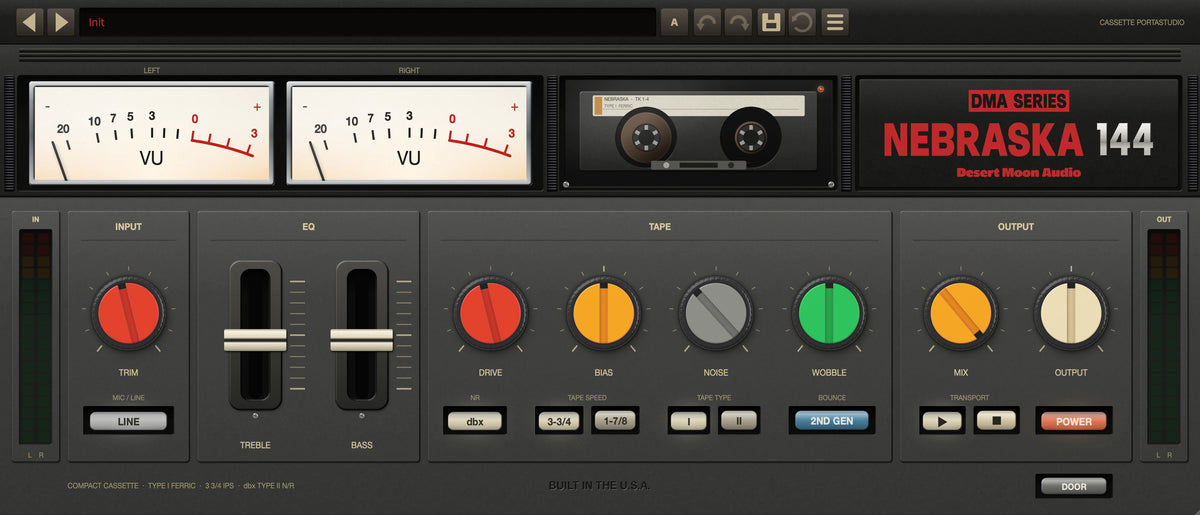
Nebraska 144 is a cassette four-track condensed into a single-channel insert. The target is a late-seventies cassette machine running through dbx type‑II noise reduction: narrow tracks, a low-mid head bump, treble that gives out around 13 kHz, an unsteady capstan, and a noise floor that breathes with the music.

It is not a four-track recorder. One input module feeds one stereo pair of tape tracks, and everything on the panel is something you would actually reach for while mixing — laid out left to right as Input, EQ, Tape, Output, the way a cassette four-track lays it out.

Key features

  • Nebraska 144 – Input

    Input

    Trim drives the preamp as a color control, with the gain taken back out afterwards. Mic position puts far more gain in front of the stage and finds the rails sooner than Line.

  • Nebraska 144 – EQ

    EQ

    Center-detented Treble and Bass faders, shelving at 10 kHz and 100 Hz, plus or minus 10 dB.

  • Nebraska 144 – Tape

    Tape

    Drive sets how hard the signal hits the oxide. Bias trades treble against grit in both directions. Tape Type I is ferric — it runs out of headroom sooner and keeps more energy in the mids; Type II is chrome, holding more treble and taking more level before it gives way. Noise injects hiss where the expander can breathe on it, and Wobble is master depth over wow and flutter.

  • Nebraska 144 – dbx, speed and bounce

    dbx, speed and bounce

    Type-II companding can be switched out, which means far more hiss and no breathing. Tape speed runs 3-3/4 or 1-7/8 ips — half speed halves the treble and raises the hiss. 2nd Gen bounces the signal through the tape a second time.

  • Nebraska 144 – Output

    Output

    Mix is a time-aligned dry/tape blend; Output is a center-detented plus or minus 18 dB trim.

  • Nebraska 144 – Behind the DOOR

    Behind the DOOR

    A service panel the front owners were never meant to open: head bump, azimuth, crosstalk, dropouts, pitch, and the wow/flutter balance — plus a hidden tape echo with send, time, repeats, tone and return.

Nebraska 144 panel, with its controls numbered

The panel at a glance

  1. VU meters Reading the tape return, left and right.
  2. Cassette window The reels turn while the tape rolls.
  3. Input trim Drives the preamp as a colour control, with the gain taken back out afterwards. Mic finds the rails sooner than Line.
  4. EQ Centre-detented Treble and Bass faders, shelving at 10 kHz and 100 Hz, ±10 dB.
  5. Drive How hard the signal hits the oxide.
  6. Bias Trades treble against grit in both directions.
  7. Noise Hiss injected where the expander can breathe on it.
  8. Wobble Master depth over wow and flutter.
  9. Tape switches dbx in or out, 3-3/4 or 1-7/8 ips, Type I or II tape, and 2nd Gen to bounce it through the tape again.
  10. Mix & Output Time-aligned dry/tape blend and a ±18 dB trim.
  11. Door Opens the service panel: head bump, azimuth, crosstalk, dropouts, and a hidden tape echo.

More details

Do I own this plugin forever?

Yes. It's a one-off purchase, not a subscription, and there's nothing to renew. Updates to a plugin you own are free — download the current installer and run it over the top.

Every plugin is sold on its own, so you can buy just the one you want. If you'd rather have all of them, the Everything Bundle collects the whole line for 30% less than buying them separately.

How many computers can I install it on?

Each license covers up to 4 computers you personally own — a studio desktop, a laptop and a couple of spares. Moving to a new computer? Choose Deactivate This Machine in the plugin's preset menu on the old one and the seat frees up instantly; if that machine is gone for good, contact us and we'll release it.

A purchase covers you, not a studio full of people. If colleagues need it, they need their own copy — that's what keeps a small company like this able to keep building plugins.

How do I get my download?

Your download link is in the order confirmation email sent at purchase, and in your account under Order history.

Your license key is in the same email. Run the installer, open the plugin, enter the key once and you're done — one key activates up to 4 of your machines.

Can't find the email? Check spam, then search for "Desert Moon Audio". If it still isn't there, get in touch with the address you ordered with and we'll resend it.

Can I run it offline?

Yes — after activation. Entering your license key needs an internet connection once; from then on it works offline — the only other time it goes online is a once-a-day check for a newer version.

If a studio machine never goes online, get in touch and we'll sort out an activation for it.

Tech specs

Mac: AU, VST3 and AAX — universal, native on Apple Silicon and Intel. macOS 10.15 or later.

Windows: VST3 and AAX, 64-bit Windows 10 or later.

DAWs: All major DAWs — Ableton Live, Pro Tools, Logic Pro, FL Studio, Cubase, Studio One, Bitwig, Reaper and Reason.

Tracking mode: drops the transport's 6 ms delay to a single sample for playing through it live. Choose it from the preset menu.

DOWNLOAD MANUAL