Cloud Seven

Cloud Seven

$59.00
Skip to product information
Cloud Seven

Cloud Seven

Stereo Reverb Processor

The big machine at the back of the rack

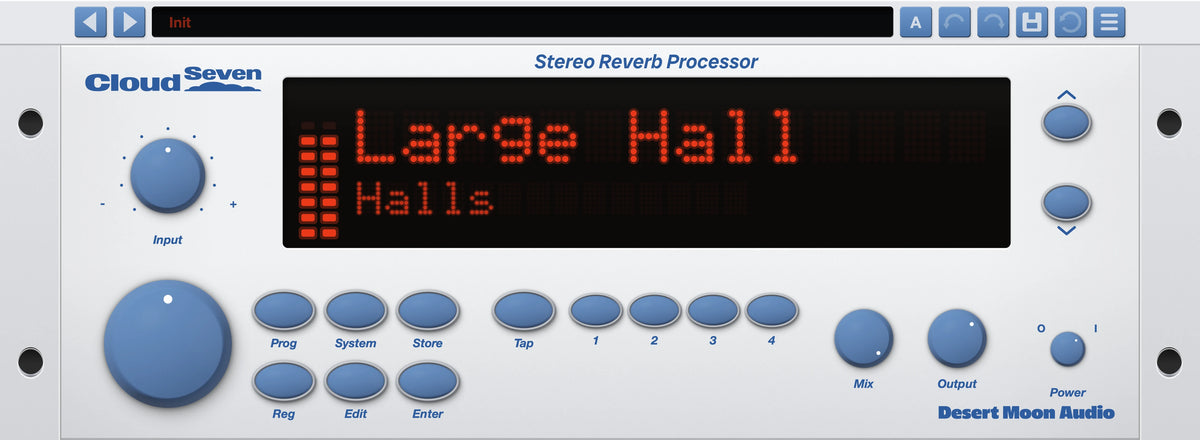
A stereo algorithmic reverb in the image of the great dedicated mainframe units, operated like the hardware: a dot-matrix display legible from across the room, an endless adjust wheel, six mode keys, and 118 factory programs in six banks — Halls, Plates, Rooms, Chambers, Ambience and Spaces. Programs load with prog → enter, tap taps in pre-delay, and fifty user registers live in the machine, shared across every session like outboard.

The engine is a 16-line modulated feedback delay network with a lossless Hadamard core — the decay you dial is the decay you get. Frequency-dependent decay with HF and LF multipliers, per-bank early reflections the tail blooms out of, modulation capped under 2 cents so it never reads as pitch, and true stereo that folds to mono cleanly.

Works with all major DAWs

AU / VST3 / AAX for Mac · VST3 for PC

Yours forever — no subscription

Instant download after purchase

14-DAY FREE TRIAL

Full version, free for 14 days. No payment details needed.

Hear the difference

Press play, then switch between dry and wet to hear the same moment through the unit.

Wurli
Vox
Piano
Pedal Steel
The Cloud Seven faceplate browsing its program banks

About Cloud Seven

The Cloud Seven is a stereo algorithmic reverb in the image of the great dedicated mainframe units — and it is operated like one. A dot-matrix display legible from across the room, an endless adjust wheel, cursor keys and six mode keys. Programs load with prog → enter, tap taps in pre-delay, and fifty user registers and four favorite keys live in the machine — shared across every instance and every session, like outboard.

Behind the faceplate is a 16-line modulated feedback delay network with a lossless Hadamard core: the mixing matrix is orthonormal, so every bit of decay comes from the per-line absorption filters and none from the matrix. The decay you dial is the decay you get — measured mid-band RT60 lands within ±5% of the number on the display from 1 to 8 seconds.

118 factory programs in six banks — Halls, Plates, Rooms, Chambers, Ambience and Spaces — each with its own early-reflection geometry feeding the tank, so the tail blooms out of the reflections instead of arriving as a second event.

Key features

Frequency-dependent decay, stated the honest way. Mid-band Reverb Time from 0.1 to 30 seconds, scaled by HF RT Multiply (0.2–1.0×) above the crossover and LF RT Multiply (0.2–4.0×) below it.

Motion you can’t hear as pitch. Sixteen slow modulators at mutually unrelated rates, depth capped under 2 cents — with deterministic seeds, so a mix recalls identically.

Per-bank early reflections. Six tap geometries, with Early Select morphing the build-up and decay envelope of each pattern.

True stereo throughout. Decorrelated left and right outputs that fold to mono without coherent build-up.

Registers and favorites in the machine. Fifty user registers and four favorite keys, stored in the unit itself and shared across sessions — like outboard.

Hardware manners. Program loads duck the wet path, clear the tank and fade back in; the power switch is a click-free bypass that settles to bit-exact passthrough; Size changes glide rather than zip.

Mix and Output on the face. Equal-power Mix where 100% is the classic send patch, and Output from −24 to +12 dB.

Walking the edit menu with the adjust wheel — reverb time, size, pre-delay
Browsing programs with the wheel and committing with enter

Quickstart tips

Start at the preset bar. Factory starting points by source — Vocals, Drums, Guitars & Keys, Strings & Orchestral, Synths & FX, Post & Dialog — each with Mix, pre-delay and Output already set for the job.

Or browse the machine’s way. Press prog, spin the wheel, and the asterisk marks the pending program; enter loads it. The wet path ducks, the tank clears, and the new space fades in.

Tap in your pre-delay. Tap in time with the song and the reverb sits in the pocket instead of on top of it.

On a send, run Mix at 100%. It’s equal-power, and 100% is the classic send patch.

Store what you find. Press store and pick a register — it’s kept in the machine, so it’s there in every session and every instance, like the hardware you’d rack next to it.

More details

Is there a free trial?

Yes — 14 days, fully featured, from the first time the plugin loads. All 118 programs, every control, no interruptions and no signup. When the trial ends, audio passes through dry until a license is entered, so your sessions are never damaged.

Do I own this plugin forever?

Yes. It's a one-off purchase, not a subscription, and there's nothing to renew. Updates to a plugin you own are free — download the current installer and run it over the top.

Every plugin is sold on its own, so you can buy just the one you want.

How many computers can I install it on?

Your license works on all machines you personally own — studio desktop, laptop, spares. Enter the same key on each; there's nothing to deactivate and no activation server, so a machine dying never costs you a slot.

How do I get my download?

Your download link and license key are in the order confirmation email sent at purchase. Run the installer, open Cloud Seven, click the notice on the display, paste the key — done.

Can’t find the email? Check spam, then contact us and we’ll resend it.

Can I run it offline?

Yes — after activation. Entering your license key needs an internet connection once; from then on the plugin runs fully offline and doesn't phone home.

Tech specs

Plugin formats: AU, VST3 and AAX (64-bit).

Platform: macOS 10.13 and up, including native Apple Silicon. Windows 10 and newer.

DAWs: All major DAWs — Ableton Live, Pro Tools, Logic Pro, FL Studio, Cubase, Studio One, Bitwig, Reaper and Reason.

Engine: 16-line modulated feedback delay network, computed from the session sample rate — 44.1 to 192 kHz.