Tri-Sonic – Tube amp, cabinet and direct box plugin for Mac and PC

Tri-Sonic

$52.00
Skip to product information
New
Tri-Sonic – Tube amp, cabinet and direct box plugin for Mac and PC

Tri-Sonic

Tube Amp, Cabinet and Direct Box

Three tube amps, nine cabinets, a room and the transformer direct box after them, on one pedal

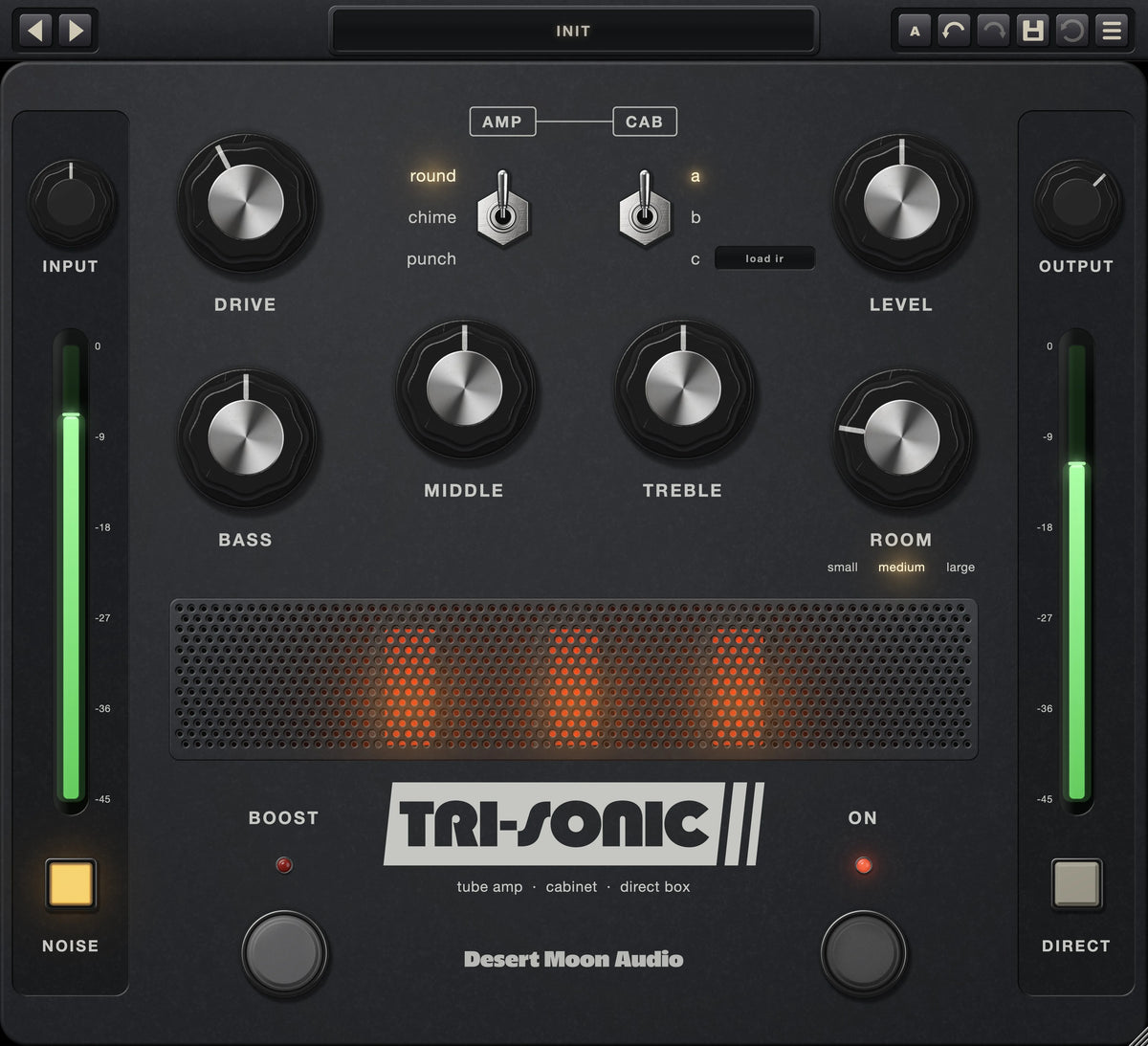
Tri-Sonic is a guitar amp plugin for Mac and PC: three tube amplifiers modelled stage by stage from their circuits, nine cabinets built from the physics of a loudspeaker in a box with a microphone on it, a room, and the class-A transformer direct box a studio guitar chain ends with. Six knobs, two switches, two footswitches: pick an amp, pick a cabinet, turn DRIVE.

14-DAY FREE TRIAL

Full version, free for 14 days. No payment details needed.

Works with all major DAWs

AU / VST3 / AAX for Mac · VST3 / AAX for PC

Yours forever — no subscription

Instant download · free updates for life

Hear the difference

Press play to hear a guitar through Tri-Sonic. Tap Dry for the same moment straight off the pickup, nothing on it.

Chime
Punk rock
Big and clean
Fat rhythm

Where it goes

Four of the places it lives.

  • The guitar track

    First in the chain, where the amp would be. ROUND at DRIVE 5, cabinet a, a touch of ROOM: the clean combo that breaks up when you dig in.

  • Rhythm that stays tight

    PUNCH at DRIVE 5, MIDDLE up, the basketweave 4x12. BASS at noon and let the cabinet make the low end.

  • Chime

    CHIME with the cut (MIDDLE) low and TREBLE up: the brilliant channel at its brightest, the cabinet's own resonance in the low end because the amp has no feedback to tame it.

  • Weight

    Any amp with LEVEL at 7 and the fader down to match: the direct box after the cabinet is driven harder and the low notes gain weight without getting louder.

About Tri-Sonic

Tri-Sonic is an amplifier in a pedal. ROUND is a 22-watt American combo's normal channel; CHIME a 30-watt British class A combo's brilliant channel with its top-boost stage and cut control; PUNCH a 100-watt British stack of the late sixties, bright channel. None of them is a drawn curve: every tube stage is solved sample by sample from its own characteristics, every tone network from the values of its parts, the two output tubes together on the shared transformer primary, on a power supply that sags under a loud chord, through an output transformer that saturates in the lows, into a cabinet whose impedance the amp actually drives.

The cabinets are not recordings. Each is a loudspeaker in a box with a microphone in front of it: the driver's resonance and mass roll-off, the cone's break-up, the box (a closed box's bump, an open back's rear wave), the microphone's presence and proximity, a second microphone for the other channel, the floor. Three per amp, and your own impulse response takes the third position whenever you load one.

After the cabinet and the room comes the stage a studio guitar chain ends with: a class-A discrete input into a custom transformer, driven by LEVEL, for the weight and finish a line signal through a good transformer DI has. ON and BOOST are footswitches: BOOST is a clean boost in front of the amp, saved with the preset, and both sit down while they are in.

Key features

  • Tri-Sonic – DRIVE

    DRIVE

    The amp's own volume knob with its taper: clean low, breaking up around noon on a hot pickup, and a clean front-end boost at the top of the range past what the amp's knob reaches. On PUNCH the volume carries its treble-bleed capacitor; on CHIME the boost tightens the low end as it rises.

  • Tri-Sonic – Three amps on one switch

    Three amps on one switch

    ROUND, a 22-watt American combo's normal channel. CHIME, a 30-watt British class A combo's brilliant channel with top boost. PUNCH, a 100-watt British stack. Each is its circuit from the jack to the speaker terminals, and the knobs become its knobs.

  • Tri-Sonic – LEVEL and the direct box

    LEVEL and the direct box

    LEVEL is the output and the level into the transformer direct box after the cabinet. Noon is unity and subtle; up, the box is driven harder for more weight and a soft limit on the biggest peaks.

  • Tri-Sonic – The tone network

    The tone network

    BASS, MIDDLE and TREBLE are the amp's pots, solved from the values of the network's parts, so every law and every interaction is the real one. MIDDLE is the fixed mid resistor on ROUND, the mid pot on PUNCH and the cut control on CHIME.

  • Tri-Sonic – BOOST

    BOOST

    A clean boost in front of the amp on a footswitch, about eight decibels: a clean setting breaks up, a crunchy one saturates. The button sits down and its lamp lights while it is in; saved with the preset and automatable.

  • Tri-Sonic – The pedal

    The pedal

    Six knobs, two switches, two footswitches, two lamps, and three output tubes glowing behind the vent as you play: the whole thing on one face, nothing hidden on a page. Room size and your own cabinet IR live in the preset menu; the cheeks either side carry the rest.

  • Tri-Sonic – ON

    ON

    The host's bypass on a footswitch. Out, the guitar passes through aligned to the unit's few samples of latency, so switching never shifts anything.

  • Tri-Sonic – The cheeks

    The cheeks

    INPUT and OUTPUT trims with a magic-eye tube meter beside each, a green phosphor bar in glass that grows with the level and warms to amber over the last three decibels. NOISE puts the amp's own hiss and hum in; DIRECT takes the cabinet and the room out for an IR loader of your own.

Tri-Sonic panel, with its controls numbered

The panel at a glance

  1. Preset bar Step through presets, the name window, A/B, undo, redo, save, revert and the menu.
  2. Drive The amp's own volume knob: clean low, breaking up around noon on a hot pickup, a clean front-end boost at the top of the range.
  3. Amp Round, chime or punch: a 22-watt American combo, a 30-watt British class A combo with top boost, a 100-watt British stack. The knobs become that amp's knobs.
  4. Cab Three cabinets for each amp, built from the physics of a speaker in a box with a microphone on it. Your own impulse response takes the c position.
  5. Level The output, and how hard the transformer direct box after the cabinet is driven: a little more is a little more weight.
  6. Bass The amp's bass pot, solved from the tone network's own parts.
  7. Middle The fixed mid resistor on ROUND (noon is the value it was built with), the mid pot on PUNCH, the cut control on CHIME.
  8. Treble The amp's treble pot.
  9. Room How much of the room the cabinet sits in you hear; the three legends under it choose small, medium or large.
  10. The vent Three output tubes behind it: the heaters warm while the pedal is on, the plates glowing with how hard you play, wavering when the supply sags.
  11. BOOST lamp Lit while the boost is in.
  12. ON lamp Lit while the pedal is in.
  13. BOOST A clean boost in front of the amp, about eight decibels; the button sits down while it is in. Saved with the preset.
  14. ON The pedal in or out: the host's bypass on a footswitch.
  15. INPUT A clean trim in front of everything, for a hot or a weak pickup: more drives the amp harder, less cleans it up.
  16. Input meter A magic-eye tube: what the amp sees, after INPUT, from -45 to 0 dBFS, amber over the last three decibels, the peak held.
  17. NOISE The amp's own hiss and hum, as a real one has at idle; off at rest, lit amber while it is on.
  18. OUTPUT A clean trim after the direct box, the last thing before the host.
  19. Output meter A magic-eye tube: what leaves the unit.
  20. DIRECT The cabinet and the room out, the amp straight into the direct box, for your own IR loader after the unit.
  21. Room size Small, medium or large, the chosen one backlit: click to choose.
  22. IR window Click to load your own cabinet impulse response into the c position; right-click to clear it.

More details

Is there a free trial?

Yes — 14 days, fully featured, from the first time the plugin loads. Every amp, every control, no interruptions and no signup. When the trial ends, audio passes through dry until a license is entered, so your sessions always open.

Do I own this plugin forever?

Yes. It's a one-off purchase, not a subscription, and there's nothing to renew. Updates to a plugin you own are free — download the current installer and run it over the top.

Every plugin is sold on its own, so you can buy just the one you want.

How many computers can I install it on?

Your license covers up to 4 computers you personally own — studio desktop, laptop, spares. Enter the same key on each; the first activation on a machine takes one quick internet check; after that it works offline, apart from a once-a-day check for a newer version. Moving on from a computer? Deactivate This Machine in the plugin's preset menu hands the seat back, and if a machine dies before you can, just ask us.

How do I get my download?

Your download link and license key are in the order confirmation email sent at purchase. Run the installer, open Tri-Sonic, click the orange strip along the bottom of the plugin, paste the key and press Activate. Done.

Can’t find the email? Check spam, then write to info@desertmoonaudio.com and we’ll resend it.

Can I run it offline?

Yes — after activation. Entering your license key needs an internet connection once; from then on it works offline — the only other time it goes online is a once-a-day check for a newer version.

Tech specs

Mac: AU, VST3 and AAX — universal, native on Apple Silicon and Intel. macOS 10.15 or later.

Windows: VST3 and AAX, 64-bit Windows 10 or later.

DAWs: All major DAWs — Ableton Live, Pro Tools, Logic Pro, FL Studio, Cubase, Studio One, Bitwig, Reaper and Reason.

Engine: three tube amplifiers solved stage by stage (triode stages by Newton's method on the tube's characteristics, tone networks by nodal analysis from their component values, a push-pull output stage on a sagging power supply, output transformer saturation, the cabinet's impedance against the stage), four times oversampled in double precision; nine synthesized stereo cabinets plus a user IR slot; early-reflection room with a late tail; a class-A transformer direct box. Mono or stereo in, stereo out; every control smoothed, amp and cabinet switches click-free.

DOWNLOAD MANUAL